
If you’re building, renovating or replacing old joinery, two window styles will come up again and again: awning and casement.
Both open outward. Both are Kiwi classics. And they often sit side by side in the same frame.
But they behave very differently once they’re open. Pick the right one for each room, and you’ll get better airflow, fewer wet sills and a home that’s easier to live in.
Here’s how they compare, and where each one works best.
The short answer:
- Choose awning windows for bathrooms, bedrooms, hallways, and anywhere you want fresh air even when it’s raining.
- Choose casement windows for living areas, and anywhere you want maximum airflow or a wide, clear opening.
- Most homes use both. It’s rarely one or the other.
What’s the difference between awning and casement windows?
The difference comes down to where the hinge sits.
Awning windows
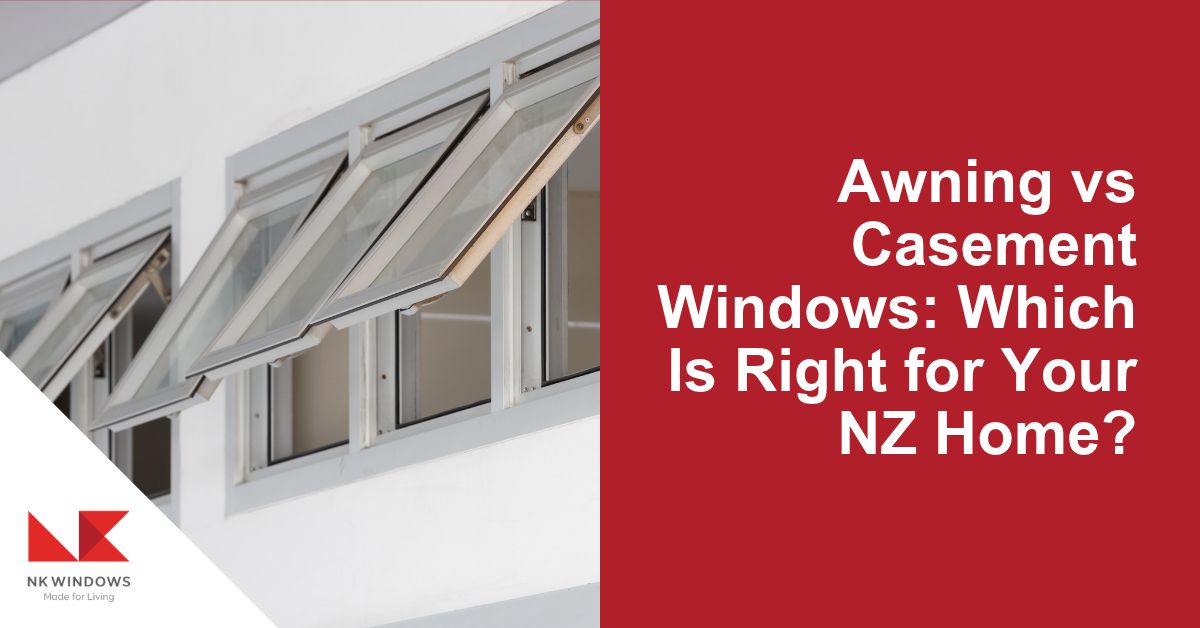
Awning windows are hinged at the top and open outward from the bottom. When open, the sash angles out and down, a bit like a small roof over the opening.
They’re usually wider than they are tall, and they’re often placed above a fixed pane of glass.
Casement windows
Casement windows are hinged on the left or right side and swing outward like a door.
They’re usually taller than they are wide, and they can open much further than an awning window, giving you a bigger, clearer gap.
Awning vs casement windows at a glance
| Awning windows | Casement windows | |
|---|---|---|
| Hinge | Top | Side (left or right) |
| Opens | Outward from the bottom | Outward, like a door |
| Airflow | Steady, moderate | High, catches passing breezes |
| In the rain | Can usually stay open in light rain | Best closed in wet, windy weather |
| Typical shape | Wide and short | Tall and narrow |
| Best for | Bathrooms, bedrooms, hallways, above benches | Living areas, dining rooms, bedrooms needing big airflow |
| Pairs well with | Fixed panes below | Fixed panes beside |
Which lets in more fresh air?
Casement windows win here.
Because they swing open from the side, the open sash can act like a scoop, catching breezes that run along the outside of your house and directing them inside. They also open further, so you get a larger gap for air to move through.
That makes casements a great choice for living areas and dining rooms, especially in summer when you want a cross-breeze through the house.
Awning windows let in less air at once, but it’s steady and controlled. For most bedrooms and bathrooms, that’s exactly what you need.
Which is better in wet and windy weather?
This is where awning windows earn their place in New Zealand homes.
Because the sash sits above the opening at an angle, it sheds rain away from the gap. In most light rain, you can leave an awning window open and keep the air moving without water getting in.
That’s a big deal for drying out bathrooms and bedrooms through winter, when closing everything up leads to condensation and damp.
Casement windows are better kept closed when the weather turns. An open casement can catch a strong gust, so they’re best for calmer days or more sheltered sides of the house.
Exposed site? Our uPVC windows are built for it. We’ve installed windows in some of the toughest conditions around, from Mt Cook Village and Twizel to Scott Base in Antarctica.
Are awning and casement windows secure?
Both styles can be very secure. It mostly comes down to the frame and the locks.
Our inwards-opening tilt & turn uPVC windows use multi-point locking, which secures the sash to the frame at several points rather than just one. With reinforced steel inside the frame, they’re very hard to force open.
When it comes to leaving windows open, awning windows have a natural advantage. The opening is smaller and angled, so it’s harder to get through than a fully open casement.
You can also add security or safety hardware to both awning and casement windows to restrict the opening size.
Which window suits which room?
Here’s a simple room-by-room guide.
Bathrooms and laundries
Go with awning windows. Set high on the wall with obscure glass, they let steam out while keeping privacy, and they can stay open in light rain.
That makes it much easier to control mould and moisture.
Bedrooms
Awning windows for overnight airflow, casement windows for big openings. An awning window can stay cracked open overnight without letting rain in.
If you want lots of fresh air on warm days, a casement alongside a fixed pane gives you both.
Kitchens
Awning windows above the bench usually work best. They’re easier to open when you’re reaching over a sink or bench, and they can stay open while you cook to clear steam and smells.
Living and dining areas
Casement windows are hard to beat. Paired with large fixed panes, they keep the view wide open while letting you get plenty of airflow when you need it.
Hallways and stairwells
Awning windows, set high. They bring in light and air without getting in the way of people walking past.
Upper floors
Think about safety and cleaning. Depending on the sill height and the drop outside, the Building Code may require restricted openings.
Cleaning the outside of outward-opening windows can also be tricky up high, which is one reason some people choose tilt-and-turn windows for upper levels instead.
Our team can talk you through the options for your home.
Can you combine awning and casement windows?
Absolutely, and most homes do.
A common setup is a casement window beside one or more fixed panes, or an awning window above a larger fixed pane. You can mix styles across the house too: awnings in the bathroom and hallway, casements in the lounge.
Our outward-opening range includes configurations like single awning, awning over fixed, two casements with three fixed panes, and plenty more. You can also customise the size, colour and glass to suit your home.
What about tilt and turn windows?
If you can’t decide, tilt and turn windows are worth a look.
They open inward instead of outward and work two ways: tilt the top in for secure, steady ventilation, or swing the whole sash in like a door for full airflow and easy cleaning from inside.
They’re especially handy for upper floors and apartments. See our tilt and turn windows to compare.
Why choose uPVC for awning and casement windows?
Whichever style you choose, the frame matters just as much as how the window opens.
- Warmer: uPVC is a natural insulator, and our multi-chambered frames paired with double glazing keep heat in during winter and out in summer.
- Less condensation: warmer frames mean fewer wet sills and less mould, unlike aluminium, which conducts the cold.
- Quieter: multi-chamber frames, airtight seals and double glazing cut outside noise.
- Low maintenance: no painting, no rot, just a regular clean.
- Made in New Zealand: our windows are made in our Christchurch factory, with glass custom-cut by Viridian.
Want to go further? Our glazing guide explains options like Low E and argon, laminated glass and obscure glass.
Frequently asked questions
Can you leave awning windows open in the rain?
In most light rain, yes. The angled sash sheds water away from the opening. In heavy, wind-driven rain, it’s best to close them.
Do casement windows let in more air than awning windows?
Yes. Casement windows open wider and can catch passing breezes, so they usually let in more air.
Are awning or casement windows cheaper?
It depends on the size, glass, and hardware, not the style alone. The best way to compare is to get a quote for your actual windows.
Are awning and casement windows good for renovations?
Yes. Outward-opening windows suit everything from villas and bungalows to modern builds, and we regularly replace old timber and aluminium joinery with uPVC.
Not sure which is right for your home?
You don’t have to figure it out alone. We’ll look at your home, how you use each room and what matters most to you, then recommend the right mix of windows without overloading you with options.
Visit one of our showrooms in Auckland, Wellington or Christchurch to see awning and casement windows up close, or book a FREE in-home consultation.