
You’ve put in new double glazing to make your home warmer and drier. Then the first cold snap arrives and you wake up to wet windows.
It’s natural to be concerned that something has gone wrong. In most cases, it hasn’t.
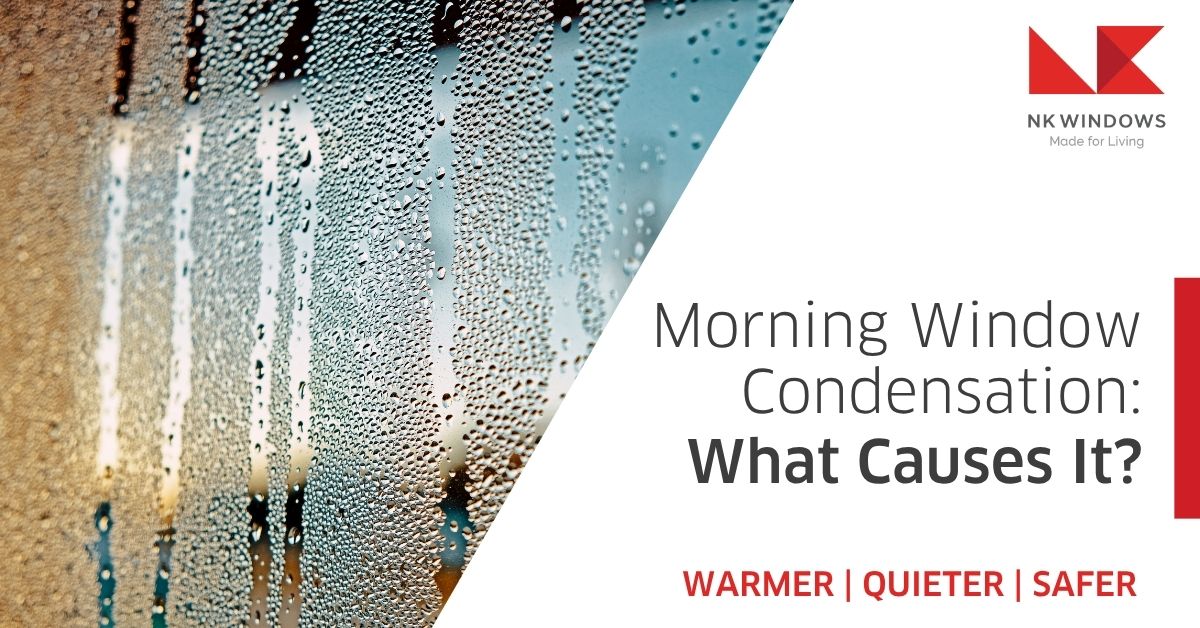
Condensation forms whenever moist air touches a surface colder than its dew point, the temperature at which water vapour turns back into liquid. Double glazing changes which surface is coldest, but it can’t change how much moisture is in the air.
That’s why the most useful thing you can do is look at where the water is sitting. It tells you almost everything you need to know.
Where is the condensation? A quick 3-part check
Start by checking if the water is on the glass inside the room. If there’s no water, check outside on the same pane. If there’s no water either side, the moisture is trapped between the panes.
| Where you see it | What it means | What to do |
| On the outside of the glass | Your glazing is keeping the heat inside | Nothing. It clears once the sun warms the glass |
| On the inside of the glass | The air in the room is holding more moisture than it can at that temperature | Cut moisture at the source and improve ventilation |
| Between the two panes | The seal on the glass unit has failed | Contact your window supplier |
Let’s start with the one that catches people off guard most, but needs the least action from you.
Condensation on the outside: a sign your windows are working
With old single glazing, heat leaked out through the glass and kept the outer surface slightly warm. Good double glazing stops that leak. The outer pane ends up as cold as the morning air, and on a clear, still night it can drop below the dew point. That’s when you see dew on the glass, just like on your car or the lawn.
“Condensation on the outside of the window indicates the Low E coating is working effectively,”
says Martin Ball, Director of NK Windows.
“This special coating is on the inside of the inner pane, and its job is to trap heat within your home.”
Low E glass makes outside condensation more noticeable because it holds even more heat indoors. Standard double glazing can still get it on the right morning, though. If you’re curious about the science, our guide to how Low E coatings and argon gas work goes into more detail.
Either way, it’s harmless and usually gone by mid-morning. If it’s blocking a view you love, a quick pass with a squeegee does the job.
Condensation on the inside is a different story. Your windows aren’t causing it, but they are telling you something about the air in your home.
Condensation on the inside: what your windows are telling you
On a cold night, the glass is often still the coldest surface in the room, even when it’s double glazed. Warm, moist indoor air drifts against it, cools, and leaves water behind. That’s why it shows up most in bedrooms with the door shut, and in bathrooms and kitchens.
As the Window Association of New Zealand puts it, windows do not cause condensation. They’re simply where you see it first.
Why it can seem worse after new windows
This is the part that surprises most homeowners. Old timber or aluminium windows were rarely airtight, and the gaps around them worked as accidental ventilation. Moist air escaped through them all night, taking a fair bit of your heat with it.
New, well-sealed joinery closes those gaps. Your home gets warmer and quieter, but the moisture you create indoors now stays inside until you deliberately let it out. So more condensation after an upgrade usually means the windows are sealing properly, not that they’re faulty.
New homes and renovations need time to dry out
If your windows went into a new build or a major renovation, there’s another source of moisture at play. Water gets trapped in the building materials during construction, mainly in the timber and concrete, and it takes around a year to dry out with good heating and ventilation. BRANZ estimates a newly laid concrete floor holds around 120 litres of water per cubic metre that has to escape as the slab cures. If you’re building a new home with uPVC joinery, expect your first winter to be the wettest and plan to ventilate more than usual.
Frames and glass make a real difference
How warm your windows stay on the inside comes down to two choices, the frame and the glass. The warmer they stay, the less condensation will form on them.
The frame
Aluminium carries the outdoor cold straight through to the inside, which is why the frame edge on older aluminium windows is often wet even when the glass is dry. Thermally broken aluminium has an insulating strip to slow this down, and BRANZ recommends it. uPVC goes further, because the material itself is a poor conductor of heat. It’s also why retrofitting double glazing into existing aluminium frames doesn’t always fix condensation: the glass gets better, but the cold frame stays. For a side-by-side look, here’s how uPVC compares with aluminium.
The glass
Our uPVC double glazed windows come with two options. Standard Double Glazing has two panes with an air gap between them. Planitherm XN fills that gap with argon gas and adds a Low E coating, which reflects heat back into the room and keeps the inner pane warmer.
If inside condensation is your main concern, uPVC frames with Planitherm XN glass will give you the warmest inside surfaces of the two.
Better frames and glass lower the odds of inside condensation, but they can’t remove the moisture itself. To do that, it helps to know where it’s coming from.
Where the moisture in a Kiwi home comes from
Everyday living puts a surprising amount of water into the air. These figures come from the Window Association of New Zealand:
| Source | Moisture added to the air |
| Drying a load of washing inside (unvented) | 5 litres per load |
| Cooking | 3 litres per day |
| Showers and baths | 1.5 litres per person per day |
| Unflued gas heater | About 1 litre per hour |
| Breathing | 20 ml per person per hour |
Add that up for a family of four that showers, cooks dinner and dries one load of washing inside. That’s around 16 litres of water a day before anyone switches on a gas heater. All of it has to go somewhere, and on a cold night a lot of it ends up on your windows.
The good news is that most of these sources are easy to manage once you know about them.
How to stop condensation on the inside of your windows
The aim is simple: make less moisture, and get rid of what you do make before it reaches the glass. These steps are listed roughly in order of impact.
- Catch moisture at the source. Run your rangehood and bathroom fan while you cook and shower, and for 15 minutes afterwards. Check they vent outside, not into the roof space.
- Dry washing outside or in a vented dryer. On wet days, a heat pump on dry mode or a dehumidifier in the laundry stops that 5 litres spreading through the house.
- Replace unflued gas heaters. They add moisture every hour they run. A heat pump or flued heater warms the room without the water.
- Air the house out every morning. Open windows on opposite sides for 10 to 15 minutes to push damp air out. Tilt and turn windows make this easy, because the tilt position lets air through while staying secure.
- Keep heating steady. A home that stays evenly warm keeps the glass above the dew point. Big swings between a hot evening and a cold night are what make windows stream.
- Use a dehumidifier in problem rooms. Bedrooms and rooms with little airflow benefit most.
- Wipe up what does form. Clearing sills and frames in the morning stops water sitting there and helps prevent mould. Our tips for looking after your uPVC frames cover the rest.
For a version you can print or share, download our Understanding and Managing Condensation guide.
These steps solve most condensation on the glass. If the moisture is trapped inside the glass itself, though, no amount of ventilation will shift it.
Condensation between the panes: when to give us a call
A double glazed unit is two panes of glass sealed around the edge, with dry air or argon gas in the gap. If you can see misting or droplets in that gap, the seal has failed and moist air has got in. You can’t wipe it away, and better ventilation won’t help.
The fix is to replace the sealed glass unit. The frame usually stays where it is. NK Windows’ glass is covered by our 10-year guarantee on profiles, glass and hardware.
It’s also worth getting in touch if:
- mould keeps coming back on your frames or window reveals
- water is pooling on sills or running onto the floor
- one window is much wetter than the others in the same room
Get in touch with our team, or visit one of our showrooms in Auckland, Wellington and Christchurch and we’ll help you work out what’s going on.
Frequently asked questions
Is it normal to get condensation on new double glazing?
Yes. Some condensation on the outside, or on the inside on cold mornings, is normal. Only misting between the panes points to a fault.
Will the condensation go away?
Outside condensation clears by itself as the day warms up. Inside condensation eases once indoor moisture is under control, and in a new build it usually settles after the first year.
Does condensation mean my windows are faulty?
Not unless it’s between the panes. On either surface of the glass, it reflects the weather or the moisture in your home rather than the window itself.
Does double glazing stop condensation?
It greatly reduces inside condensation by keeping the inner pane warmer, but it can’t remove moisture from the air. That still needs good ventilation.
Does triple glazing reduce condensation?
Yes. A third pane keeps the inner glass even closer to room temperature, which is one reason people choose triple glazing for colder parts of the country.